
Some places hold onto their stories. The land remembers, even when the people who walked it have moved on. Camp Mishnoah is one of those places.
For nearly a century, this piece of land on the shores of Lake Siog in Holland, Massachusetts has been a gathering place. A spot where people come to step away from their everyday lives and into something quieter. The buildings have changed. The purpose has evolved. But the feeling? That’s been here since the beginning.
And long before the buildings, the land itself was drawing people in.
Before the Camp: The Land on Lake Siog
The name “Siog” comes from the Nipmuck people, the Indigenous community who lived in this region for centuries before European settlement. In their language, “Siog” means pickerel, a type of freshwater fish that filled the pond. The shores of Lake Siog were a center of Nipmuck life.
Arrowheads were once so plentiful here that early settlers assumed a great battle must have taken place. The more likely explanation is simpler and more meaningful: this was a place where people lived, gathered, and thrived. The open meadows offered good hunting. The sandy soil was easy to work. The water was full of fish. People were drawn here because the land provided for them.
That thread runs all the way through to today.
A Name Carried Forward
The name “Mishnoah” is older than the property itself. It originally belonged to a camp in Southwick, Massachusetts, run by the Springfield Women’s Club. The exact meaning of the word has been lost to time. No one seems to know for certain where it came from or what it was meant to convey. But when the Springfield Girls Club needed a name for their new camp in Holland in 1928, they carried “Mishnoah” forward, giving it a second life on new ground.
There’s something fitting about that. This has always been a place defined less by its name and more by what it feels like to be here.
The Springfield Girls Club
The story really begins with a woman named Nellie E. Sunderman. In 1917, Sunderman arrived from New York to manage the Springfield Girls Club, and she immediately set about expanding what the organization could offer. By 1921, she had opened a day camp at Lake Lorraine, sending girls out by truck and trolley each morning and bringing them home each night.
By 1924, the Girls Club was running two overnight camps at the same time. One in Southwick (the original Camp Mishnoah) and one called Camp Greenwich, a property that had been gifted to them by the Goodwill Home for Girls. The two camps were forty miles apart. As Sunderman herself later wrote, the arrangement required “two sets of workers, two sets of books, two weekly camp parties, the care of two pieces of property, and two of everything.”
By 1927, it was too much. The Girls Club closed the Southwick camp and sold Camp Greenwich to the state for $10,000. That land in Greenwich would eventually disappear beneath the waters of the Quabbin Reservoir, Massachusetts’ largest body of drinking water, created by flooding four entire towns in the 1930s.
A New Beginning on Lake Siog
With the money from the sale, the Springfield Girls Club purchased 10 acres on Brimfield Road in Holland for $7,200. An old barn on the property was converted into a dining hall. Five cabins were built that first year, many by a local carpenter named Andrew Bagley, who lived on Lake Siog just down what is now Pond Bridge Road. Local civic organizations, including the Kiwanis Club and the Rotary Club, pitched in with funding, labor, and furnishings.
Camp Mishnoah opened in the summer of 1928.
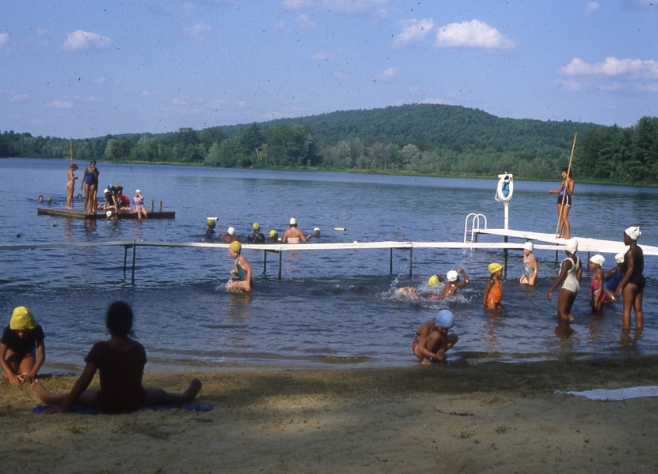
For decades, it operated as a summer overnight camp for girls. Campers spent their days swimming in the lake, playing tennis, making crafts, and eating breakfast together in the dining hall. Boating was a favorite activity, though only counselors were allowed to row. The girls slept in cabins nestled among the trees, and for many of them, it was their first real experience of the woods, the water, and the kind of independence that comes from being away from home.
A postcard from 1931, sent from a camper named Edwina to her Aunt Rose, reads simply that she was fine and at camp for two weeks. A Holland resident later shared that she attended Camp Mishnoah in 1942, when she was twelve years old. These small fragments are what remain: postcards, memories, and the land itself.
Over the years, more buildings were added until the property held seventeen structures in all. The Springfield Girls Club eventually became the Boys & Girls Club Family Center, and Camp Mishnoah continued serving Springfield’s young people for generations.
A New Chapter
After many years of operation, the Boys & Girls Club Family Center sold the property in December 2019. Sue, the current owner, saw something in the overgrown grounds and aging buildings that others might have overlooked: potential.
Sue didn’t just buy the property. She moved onto it. She lives on the land, surrounded by the lake and the forest that have defined this place for almost a hundred years. From the beginning, the restoration has been guided by her vision and her own hands, bringing warmth, coziness, and a deep respect for nature into every decision she’s made. From the way the cabins are decorated to the spaces she’s created for gathering and reflection, the care is personal.
The work is ongoing, and it’s significant. Some buildings have been beautifully restored and are already welcoming guests. Others are still in progress. A few structures that couldn’t be saved are being cleared to make way for what comes next. It’s a labor of love, the kind of project measured in years, not months, and Sue’s vision is coming to life a little more with each season.
Today, Camp Mishnoah is becoming Mishnoah Retreat. The cabins that once housed summer campers are being restored to welcome guests from across New England and beyond. The lake is still here, still quiet, still surrounded by forest. And the feeling of arriving at a place that’s set apart from the rest of the world? That hasn’t changed at all.
| Year | Milestone |
| Pre-colonial | The Nipmuck people settle the shores of Lake Siog ("Siog" is the Nipmuck word for pickerel) |
| 1917 | Nellie E. Sunderman begins managing the Springfield Girls Club |
| 1921 | The Girls Club opens a day camp at Lake Lorraine |
| 1924 | The Girls Club takes on two overnight camps, including the original Camp Mishnoah in Southwick |
| 1927 | Camp Greenwich is sold to the state (the land later floods to create the Quabbin Reservoir) |
| 1928 | The Holland property is purchased for $7,200; Camp Mishnoah opens on the shores of Lake Siog |
| 1928 to 2019 | Camp Mishnoah operates as a summer camp for girls under the Springfield Girls Club (later the Boys & Girls Club Family Center) |
| 1928 to 2019 | Sue purchases the property and begins restoration |
| 1928 to 2019 | Restoration and renovation of the property is underway, transforming Camp Mishnoah into Mishnoah Retreat |
Visit a Place with a Story
Nearly a hundred years of history live in these buildings, these trails, and the shoreline of Lake Siog. When you stay at Mishnoah Retreat, you’re not just booking a cabin. You’re stepping into a place that has welcomed people seeking nature, community, and a change of pace since 1928. And on land that has drawn people to it for far longer than that.